Fight Club Sorry Lou Could You Run It by Me Again
Scanners
Fight Social club: I Am Jack'southward Manic-Depression
Fight Social club: I Am Jack'southward Manic-Depression

"...At that place is nothing either skillful or bad, but thinking makes it and then. To me it is a prison." -- "Hamlet" Human action 2, scene 2
If you've ever suffered from clinical depression, you know the feel is impossible to convey to someone who hasn't also gone through it. Information technology doesn't make sense. It's like trying to depict why you love somebody. How do y'all explicate a lack of feeling, or interest, or pleasure, that is both numbing and excruciatingly painful? How do you account for a disconnection with the past and any formulation of a future? Information technology's non "living in the moment" -- it'southward beingness stuck in a moment from which you tin't imagine whatever escape -- not just the feeling that this asphyxiating near-deadness volition keep forever, just that y'all can't imagine ever having felt any other way (fifty-fifty though, logically, yous know that is non possible). You can remember feeling pleasure -- no, make that "having felt pleasure" -- but you lot have no retentiveness of what it really felt like.
One of the (many) reasons I probably connect so strongly with David Fincher's "Fight Society" (1999) is that, by capturing clinical low more than accurately than any other movie I've ever seen (though Laurent Cantet's "Time Out" and Eric Steel's "The Span" delve mighty deep into that abyss), information technology helped shake me out of the grips of a depression that was sucking me down at the fourth dimension. I was the only person in the theater convulsed with laughter from beginning to terminate, because it was liberating, exhilarating, to see the truth of my own inner experience reflected back at me in its funhouse mirror. I recognized myself in the moving-picture show, relished the psychological acuteness of what I was seeing, felt its black absurdity resonate in my poor, chemically imbalanced noggin. From the very outset images deep inside the human brain, I felt it could not be about anything else, even though I didn't know where it was going to get from at that place.
(Spoilers? Oh, yes.)
Beneath is my ii minute, 25 second distillation of what I meet every bit the essence of "Fight Guild." Notice that only one dial is thrown and that the physical/psychological violence is inner-directed (shrinks say depression is rage turned inward) and apocalyptic (small gestures are out of the question when your world is imploding). Press play:
"How'south that working out for you? Beingness clever." -- Tyler Durden
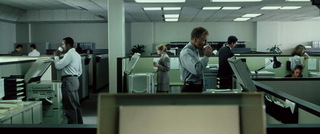
"Fight Club" is, quite intentionally, a motion picture that is besides clever by one-half, and patently too amused by its ain cleverness. That'southward also precisely what it is meant to be, every bit a comedy that takes place entirely inside one immature young man'south head -- a thirtysomething white-neckband wage-slave Everyman (Edward Norton) who doesn't have a name but who (for reasons revealed in the movie) we'll phone call Jack. At the beginning of the movie, Jack says he hasn't slept for half dozen weeks (which is not possible, so nosotros know he's prone to exaggeration well-nigh his own experience). His indisposition has left him feeling that his life is "a copy of a re-create of a re-create," as his narration echoes away, fading out of the soundtrack even every bit he speaks it. A paper Starbucks coffee cup rides back and forth on the copy car he's using, and everyone in the part takes a sip of their Starbucks in synch with the office machines.

The first fourth dimension I saw the movie, up close to a mighty big screen in a sparsely populated theater, and I noticed what appeared to be a chemic splotch on the motion picture, or peradventure a bad splice, in this sequence. Ane or ii others went by before I realized that this wasn't a damaged print (I've seen plenty of poorly inspected prints, even on opening days), merely a character leaking into the flick. Those flashes of Tyler Durden (later addressed indirectly in the project booth, where he points out a changeover mark on the print nosotros're actually watching, and splices frames of pornography into family films) are something I've actually experienced when in depression. Senses are dulled, and sometimes -- just for a flash -- you lot may call back you've seen something out of the corner of your heart that isn't there: a shadow, a issues, a person (see mirror scene in Polanski'southward "Repulsion"). Y'all may retrieve you're going insane. I practice.
In the eye of a recent depression (I'm just coming out of one -- which is why I oasis't been able to post at my accustomed pace), I had ane of the most horrifying experiences of my life. I woke upward convinced that I had murdered some people in a especially encarmine fashion. Hacked them apart. I didn't know who they were, and I didn't remember how I had done it, but I was awake and all of a sudden facing the reality of what I had done. But how could that exist? I couldn't accept repressed the retentivity of that, could I? Every bit I started to wake up a footling more, I thought: No, you didn't practice it yourself, but you witnessed information technology.
Either way, it was too much to handle, but yous didn't do anything almost it. How could I have not reported what I saw? How could I have forgotten what I saw until just now, when information technology came flooding back into my consciousness like the blood from the elevator in "The Shining"? (Yep, several recent posts take been fallout from this dream.) It took me about ii or 3 days to convince myself that this had been, in fact, a semi-waking dream. What's particularly odd to me is that I very rarely have dreams of violence -- although I was plagued by dreams of watching a jetliner fall out of the sky in the twelvemonth before -- yes -- September eleven, 2001. After that, they stopped. No, I don't believe in precognition, just at that place it is.
Later, after I was pretty sure I had neither committed nor witnessed mass murder (in existent life, and non in the movies) I idea back to "Fight Gild" and Jack's panic and guilt when he realizes he's been the ane who, without existence consciously aware of it, has unleashed a fascist/terrorist movement known every bit Project Mayhem, the fanatical members of which are implementing, under his management, plans to bring down skyscrapers in Los Angeles. (More nine/11 imagery -- though ii years before the actual result that then many people described as being then shocking and unbelievable that it was "like watching a movie." Yeah -- this picture show.)
 Prison by Ikea.
"Fight Club" begins with Jack feeling trapped in a rut that some people would recognize equally true low. I presume that Northwestern writer Chuck Palahniuk, who wrote the novel on which the film is based, has some first-manus experience with chronic depression -- which has nothing to exercise with feeling bummed nigh something that'due south happened in your life (though that can aid trigger an episode). Palahniuk is not subtle, and neither is "Fight Order" -- but depression is not subtle, either. It's all-consuming, and the thought of somebody who could come up along and dial you out of it, just so you could feel some kind of real contact with the world instead of seeing it from far abroad equally though anesthetized remove, is a pretty good metaphor. Possibly only somebody who'due south experienced depression tin fully go far tune with it. I don't know what it's like to not have experienced it.
"While both Tyler and Jack are capable of extended neo-macho riffs on the virtues of Fight Guild, that doesn't prevent the whole concept from playing like the delusional rantings of testosterone-fond thugs. Aside from the protracted beatings, the film is so vacuous and empty it's more depressing than provocative." -- Kenneth Turan, Los Angeles Times (from the "Fight Order" DVD booklet)
"If I had a tumor I'd name it Marla." -- Jack, "Fight Club"
The depressive land is beyond nihilistic (an adjective freely applied to "Fight Order"), rendering absolutely everything unexplainable, irrational, absurd and utterly meaningless. (It's recognizable in the suicidal soliloquies of "Hamlet": "How weary, stale, flat and unprofitable seem to me all the uses of this earth!") Only once you emerge from information technology, its bleakness and absurdity can seem quite funny (in a self-loathing/solipsistic kind of way). Trying to explain it to someone who hasn't experienced it is fruitless. Simply, even though information technology frightens people and makes them desire to avert me like the plague when I get onto the subject (or possibly that's but their alibi), I can't help but give it a shot whenever I start obsessing. For now I'll just say that it feels like beingness on a desolate planet, where the temper itself is thick and toxic and hard to exhale. You can see the earth indistinctly, but information technology is unimaginably distant. You lot tin can't remember how long you've been on this planet, but you suspect that you may always have been, though intellectually you lot know that isn't possible. Information technology just feels that way, and you can't remember feeling whatsoever other way.
Then, back to Jack and, eventually, Tyler. Tyler is certainly Jack's Id, just he's also Jack's glib, sophomoric, idea of what he would like to be -- hence, the object of his hero-worship. Just before they exchange their first punches, Jack and Tyler have a cliched chat in a bar about their essential nature every bit consumers. Jack describes his life in terms of a sofa, a decent stereo and wardrobe that was getting to be respectable: "I was close to beingness complete." And then it all blows upwards in his face. Tyler says (with insufferable adolescent pretentiousness), "The things you own, cease upward owning you lot." Is this a brilliant insight? Hardly. You should be laughing at the characters, not with them. Information technology'due south part of what strikes me every bit so damned funny nearly "Fight Club": It is specifically about a (privileged, pouty, petulant, spoiled, incomplete, cocky-pitying) upper-middle-course white urban heterosexual male in his 30s trying to figure out who he is versus who he thinks he is supposed to be -- circa 1999, eve of the supposedly apocalyptic new millenium. You wonder why it's packed with exaggerated manlike posturing? Look around. (The homoeroticism in the film is more accurately narcissism, and I discover information technology fascinating that and so many women seem to recognize the pinpoint truth of its portrayal of men than a lot of men practice. And then once more, who doesn't want to be as cool as Brad Pitt/Tyler Durden, an effortlessly beautiful man whose terrible, tacky wardrobe and bizarre hygiene both misconstrue and perversely enhance his beauty and coolness? That chip with the condom glove as he'southward having sex with Marla is hilarious -- an obscurely tantalizing sexual aid not unlike the buzzing box in "Belle de Jour.")
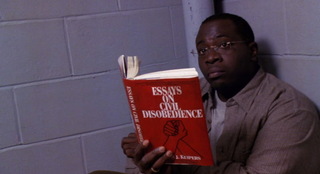
I think of the inspired "Harold and Kumar Go to White Castle" (and the vivid "Pineapple Express"), 2 stoner-buddy adventures that are virtually (and, in fact, are) the movies these guys would make up while smoking a bell on the couch -- the movies they would like to run into, and star in. (See Jean-Pierre Leaud's plaintive comment in Jean-Luc Godard'due south "Masculine Feminine" about "the film nosotros had dreamed, the picture we all carried in our hearts, the motion picture we wanted to make... and secretly wanted to alive.") Then when, for instance, Harold is thrown in jail, his cellmate is of grade a big black guy... who sits quietly in the corner reading "Essays on Civil Disobedience." Harold asks what he'due south in for. "For being black," he says. The joke is non so much that he's the antithesis threatening blackness thug nosotros take been conditioned to expect in dumb teen comedies, and he is instead a mild-mannered, articulate, bespectacled intellectual who was arrested outside a Barnes & Noble and who winds up quoting the Desiderata -- a proto-New Age poster/plaque phenomenon of the 1970s alike to Kahil Gibran's "The Prophet" or "Dearest Means Never Having To Say You're Lamentable." What's funny is the concept that you lot know the movie knows what a trite and belabored joke that is. The dial line is yet another well-timed reversal, a crass endorsement of racial stereotypes that, of form, isn't. (My complaint against the cliches of "American Dazzler" is that I remember they are intended to be taken at face value -- similar the gruff military guy who turns out to be a closeted gay. Merely, every bit Tyler says, I could be incorrect. Simply I don't encounter the evidence in the movie.)
As for the violence: Damn right information technology's pointless. That'south the point. Information technology's not near pummeling mankind, but nigh punching through a big ol' sack of psychological insulation. Why does Jack impulsively beat the crap out of Jared "Angel Face up" Leto's gilt-framed puss? He says it out loud in the movie: "I felt like destroying something beautiful." Next question?
I know that what I've written hither is at least as much virtually me as about "Fight Club" itself, simply that'southward why I re-published the earlier entry first. I'm attempting to show how my response to "Fight Social club" (which I all the same defend as a terrific movie) is informed -- or, if you lot prefer, influenced -- past my personal experience. I could say the same thing about other favorite movies, similar Woody Allen's "Annie Hall" or Wim Wenders' "Kings of the Road" or Buster Keaton's "Our Hospitality." Every bit I've said before, I don't expect to modify anybody's opinion of "Fight Guild," non just considering views in either direction tend to be quite visceral (as they damned well should exist), just because my accept on it is so personal. I don't hateful to employ depression as a style to rationalize my enthusiasm for the picture, but maybe I am to some extent. As with the depression itself, I can only endeavor to explain what I feel.
* * * *
Endnote: I'd like to address some of the comments in the "Fight Over Fight Club" post. Commencement of all, feel free to hate the movie. That'south a perfectly good for you reaction to a motion-picture show that, in its time, It is contemptible -- though non necessarily in the ways many of its detractors (i.eastward., nearly critics and audiences in 1999) have claimed. (How "trigger-happy" can a comedy about a guy chirapsia upwardly on himself with his blank fists really be?) Like David Cronenberg'southward "Crash," the movie was pilloried, even by many inside the movie industry, who considered it dissentious and dangerous. This is the context in which my 1999 article appeared.
According to Sharon Waxman's 2005 book "Rebels on the Backlot" (which, I acknowledge, has to exist taken with a grain of common salt because some chapters are riddled with factual errors and misinterpretations), the heads of distribution and marketing at Fox "disliked the film intensely.":
And and then on. Of form, I didn't know all of this when I first saw the movie, and was merely enlightened of a tiny sliver of it when I wrote my 1999 article. But I'm not surprised. I notwithstanding retrieve a lot of people like information technology (and loathe information technology) for the wrong reasons. But they are non my reasons. If I read the movie the way many of its detractors exercise, I'd hate it, besides.Ed Norton recalled that in the very get-go marketing meeting for the film with Fincher and the studio, [marketing chief Robert] Harper opened the discussion with the following: "Tin can anyone tell me ane f***king thing nigh this movie that is funny?" [...]
[Critic David Thompson] wondered if Fincher wasn't a terrorist of sorts; "I can't help wondering whether the social scientist in Mr. Fincher wouldn't be like the cat that swallowed the cream if a riot of copycat fisticuffs ensued.... David Fincher's bristling mental attitude is no defence against rubbish." [...]
[Critic] Stephen Hunter seemed to praise the pic in the Washington Post despite himself.... "Sympathise, I am not writing a defence force. The movie is indefensible, which is what is so cool about it. It's a screed against all that's holy and noble in man, a yelp from the blackness hole." [...]
The issue migrated off the arts and leisure pages onto the opinion and editorial pages. "Fight Guild" was repugnant. "Fight Guild" was immoral. "Fight Society" was a disgrace. Fifty-fifty people within Hollywood were outraged. [...]
[Hollywood Reporter editor Anita Busch] wrote that the picture "will become Washington's poster child for what'southward wrong with Hollywood. And Washington, for once, will be right.... The film is exactly the kind of product that lawmakers should target for existence socially irresponsible in a nation that has deteriorated to the indicate of Columbine." Busch likewise presided over 2 news articles that slammed the flick, including one that quoted producers and agents (anonymously, of class) saying the motion-picture show was "loathsome," "absolutely indefensible," and "sorry on every level." [...]
The vice chairmen of Paramount's Movement Movie Group, Robert Friedman, pulled aside producer Art Linson at the Paramount commissary and pleaded, "How could you?"

The hyper-glossy/faux-grimy fashion of the movie precisely captures what it's well-nigh: commercial culture'southward ability to co-opt and capitalize upon annihilation remotely rebellious and individualistic, and turn it into consumer goods. (See how fast the major record labels subsumed the "counter-culture" of the 1960s, or how Hollywood emulated the "indie" spirit of "Piece of cake Rider" or "Pulp Fiction," or how the music industry immediately embraced and captivated Seattle'south "grunge" scene and slapped information technology with the marketable mainstream "alternative" label.)
Why, you may ask, does the movie look like a GQ or Vanity Off-white layout (or an Ikea itemize centerfold)? Why does information technology take what now look like easy potshots at Starbucks or Apple tree? Because it is indeed emulating the manner information technology's criticizing, a globe in which nuclear families themselves are franchises -- as Fight Lodge becomes. (In the case of the movie itself, the theatrical marketing campaign failed miserably.) Jack and Tyler rant and rave against consumer culture, Microsoft, Starbucks, Calvin Klein, Tommy Hilfiger and the masturbation known every bit cocky-improvement -- but they exist in that earth, and are products of it. Every bit they walk past a naked Gucci male child ad on a bus finish, Jack asks Tyler: "If you could fight any celebrity, who would it be?" For Tyler it's Hemingway (a celebrity!), and for Jack it'southward "Shatner." Are these guys (er, is this guy) phony and hypocritical about the phoniness and hypocrisy of contemporary capitalist society? Yep. And so is Holden Caulfield. That's role of the joke, and part of the poignancy.
* * * *
P.Due south. Nearly my dream... I attribute information technology to some late-nighttime conversations nigh the amazing documentary "The Staircase" and Errol Morris's "Standard Operating Process," then staying upwardly very belatedly the two previous nights and watching "Roman Polanski: Wanted and Desired" and "Ghosts of Abu Ghraib." What can I say? I'thousand an impressionable fellow (and y'all know what happens to impressionable fellows; they lose their... bearings). At that place are themes almost claret, guilt and repression/denial that run through all these documentaries, only perchance the well-nigh powerful for me was "Ghosts of Abu Ghraib" (the essential companion piece to Morris's film) in which soldiers stationed there described how they had to consider themselves already dead in order to stay there without going insane. Once they had shut downwardly, out of necessity, the world seemed like a hallucination to them. They were numb, but also put in the position that Noah Cross asserts in "Chinatown": "Most people never take to face the fact that at the right fourth dimension and the correct place they are capable of anything." What most terrifies me is the truth of that statement. (And I think it's one of the lessons of Abu Ghraib. There is no "them," only us.)
My dream-dilemma was, in some ways, the inverse of Hitchock's "Wrong Man" obsession. It wasn't that I was accused and convicted of something I didn't exercise, it was that I had done something that nobody, including myself, had previously known well-nigh. My sentence, you might say, was to learn how to live with that cognition (I but saw "In Bruges" last night, my favorite flick so far this year) -- and my need to confess information technology, with the fear that no one would believe me considering I didn't know how to find the evidence. If yous've seen any of the to a higher place movies, y'all will detect some of the connections.
Especially odd: The very next calendar week I started to watch the first season of "Heroes" on DVD. One of the characters has a split up personality (which works nicely as a metaphor for manic depression) and basically lives my dream! Information technology was pretty shocking to lookout man. She wakes up to find blood and bodies all over her garage studio, wonders who could have committed such atrocities, and then has to face up the fact that it was herself (or her alternate self). Another character has nightmares of a nuclear explosion that devastates New York -- and in which he himself is the bomb that causes it. Watching these things was rather uncanny under the circumstances.
I somehow feel that my life will e'er be divided into earlier that dream (because it extended so far into my waking life) and afterwards information technology. The way I expect at it, I don't know (and hope I never exercise) what information technology's like to slaughter a bunch of people. But I know exactly what information technology feels like to have slaughtered them. Considering I really idea I had. And, like it or not, I can't just say, "Oh, it was just a dream" (only a movie, but a moving picture). I yet take to live with what information technology felt similar.
P.P.Due south. Delight read critic Michael Atkinson's essay, "Ghost in the Vanquish," about his brief bout with depression. His experience doesn't quite mirror my own (perchance information technology's somewhat different for everybody), but information technology's one of the virtually insightful pieces I've ever seen on the subject.
Latest blog posts



Latest reviews
Comments
Fight Club Sorry Lou Could You Run It by Me Again
Source: https://www.rogerebert.com/scanners/fight-club-i-am-jacks-manic-depression
0 Response to "Fight Club Sorry Lou Could You Run It by Me Again"
Post a Comment